
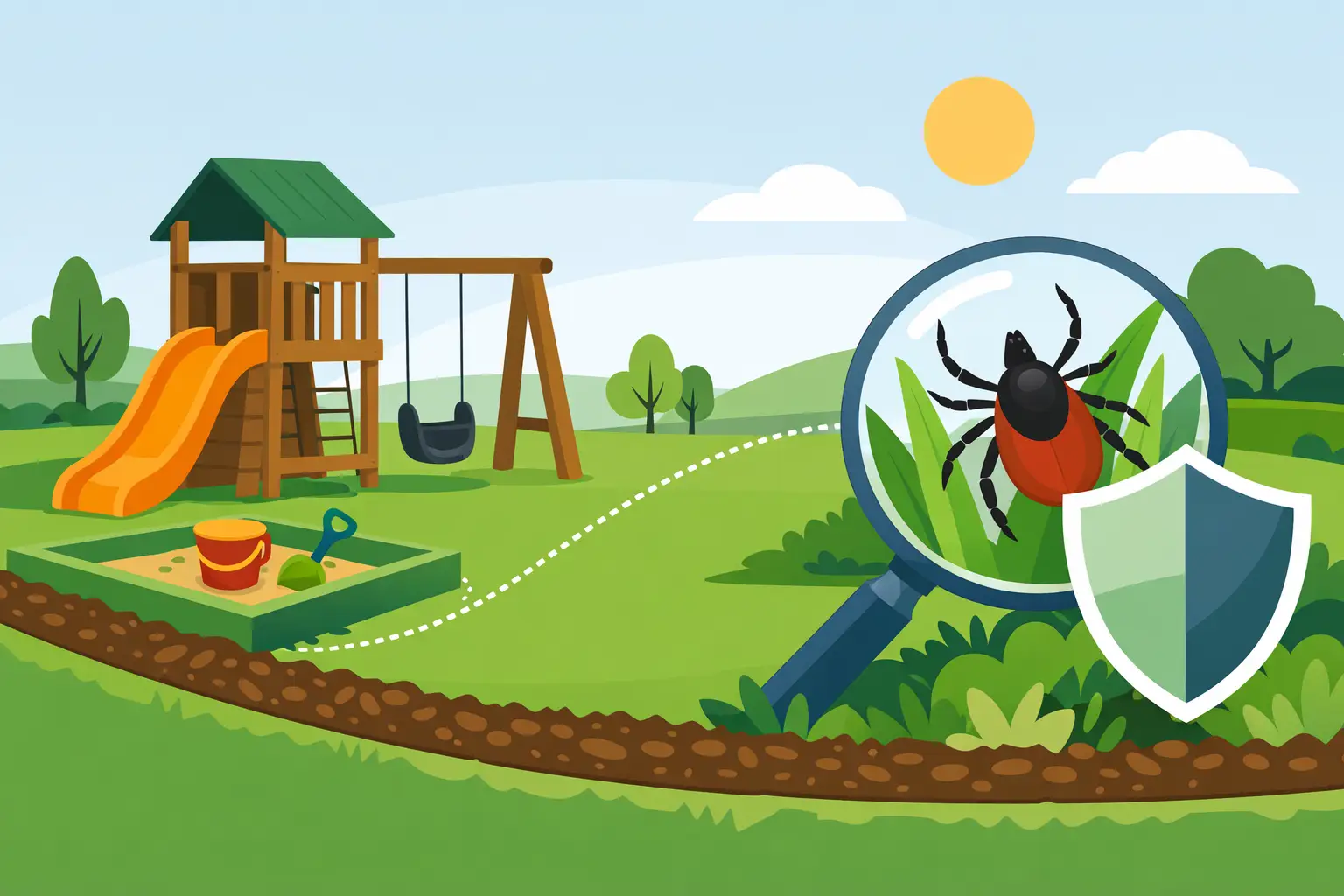
A swing set tucked beside tall grass might look harmless, but that edge is exactly where ticks tend to wait. Effective tick prevention around play areas starts with understanding that ticks do not spread evenly across a yard. They cluster in damp, shaded spots, along fence lines, under shrubs, near woodpiles, and where lawns meet brush or leaf litter.
That matters for families because children rarely stay in the centre of the lawn. They run to the sandbox, crawl near play structures, cut through side yards, and chase pets into the corners adults do not think about. If your goal is to make outdoor time safer, the smartest approach is not spraying everything and hoping for the best. It is reducing tick habitat around the places your family actually uses.
Why ticks show up near play spaces
Ticks need moisture and shelter more than they need open sun. A well-kept lawn in full daylight is usually less attractive than the cool strip behind a shed, the overgrown area beside a fence, or the shaded mulch bed around trees. Many play areas end up close to those edges because that is where there is room for them.
In Ontario, that creates a real concern during the warmer months. Blacklegged ticks can carry Lyme disease, and exposure often happens in ordinary residential spaces, not just on hiking trails. A backyard can look clean and still have the conditions ticks prefer.
Pets can also move ticks from one part of the property to another. A dog that brushes through shrubs or wooded edges may carry ticks back toward patios, decks, and play equipment. So when homeowners think about tick prevention around play areas, the issue is not only the play zone itself. It is the route ticks take to get there.
Start with layout, not just treatment
The best results usually come from property changes first, then treatment where it makes sense. That is especially true if you want to reduce exposure while keeping the yard comfortable for kids and pets.
If you are planning a new play set, choose the sunniest and driest practical spot on the property. Avoid placing it tight against tree lines, dense shrubs, ravines, or unmowed sections of lawn. Even shifting a play structure a few metres away from a wooded edge can make a difference because ticks are far less active in hot, dry, exposed areas.
For existing play areas, create separation. A buffer of gravel, stone, or dry mulch between the lawn and a brushy border can help limit how easily ticks move into higher-traffic zones. This does not make a yard tick-free, and it is not a substitute for treatment in high-pressure properties, but it can reduce the chance of ticks settling right where children play.
Yard maintenance that actually helps
Some routine yard work makes a noticeable difference, while other tasks are often overestimated. Mowing matters, but not because a shorter lawn alone solves the problem. What it really does is reduce humidity at ground level and make the space less inviting around active use areas.
Leaf litter removal is often just as important. Ticks thrive in damp leaves, organic debris, and neglected edges. If the area around a swing set, sandbox, or climbing structure collects fallen leaves and stays shaded, that is worth addressing quickly.
Shrub trimming also helps by opening up airflow and sunlight. The goal is not to strip every garden bed bare. It is to reduce the cool, protected hiding spots ticks prefer near paths, fences, and play equipment.
Woodpiles should be kept away from play spaces if possible. They attract rodents, and rodents can support tick populations. The same goes for brush piles and unmanaged naturalized corners right beside family activity areas. A more natural yard can still be compatible with tick reduction, but the transition between wild space and play space needs to be intentional.
Tick prevention around play areas needs zone thinking
A lot of homeowners picture tick control as one big yard-wide decision. In practice, it works better as a zoning problem. Where do kids play? Where do pets roam? Where is the high-risk edge? Those answers shape the plan.
The highest priority zone is the immediate play area and the routes leading to it. That includes the lawn path from the back door, the area around play structures, the perimeter along nearby shrubs, and any shaded corners children use regularly. The next zone is the boundary where ticks are most likely to enter from adjoining habitat such as tree lines, long grass, or neighbouring brush.
This is why customized treatment matters. A property with a play set in open sun may need a very different strategy than one with a sandbox near cedar hedges and a wooded back lot. Blanket spraying can use more product than necessary without focusing enough on the places that drive exposure.
When professional treatment makes sense
Good yard habits reduce risk, but they have limits. If your property backs onto woods, has frequent wildlife activity, stays damp and shaded, or has already had tick sightings, maintenance alone may not be enough.
That is where targeted barrier treatments can help. A professional approach should focus on the edges, harbourage zones, and shaded transition areas where ticks live and travel rather than treating the whole yard as if every section carries the same risk. For families, that matters not just for effectiveness but for peace of mind. Precision is better than over-application.
This is also where homeowners should ask practical questions. Is the treatment designed around how the yard is used? Are the play areas, pet routes, and gathering spaces part of the plan? Is the provider minimizing spray volume while still treating the right locations? Those details tell you whether the service is built around protection or just coverage.
For properties in places like Kemptville, Smiths Falls, and surrounding communities where yards often border fields, woodlots, or rural edges, tailored tick control is especially valuable because the pressure can change significantly from one lot to the next.
What parents and pet owners should do after outdoor play
Even with strong prevention, checks still matter. Ticks are small, and early removal lowers risk. After outdoor play, it is worth doing a quick routine before everyone settles in for the evening.
Check along the hairline, behind the ears, around the waistband, under the arms, behind the knees, and around socks and shoe lines. With pets, check around the collar, ears, chest, and between the toes. These checks do not need to feel alarmist. They should just become part of the same rhythm as hand washing or taking off muddy shoes.
Clothing choices can help too, especially in higher-risk parts of the yard. Closed-toe shoes and light-coloured clothing make ticks easier to spot. But clothing is a backup measure, not the main plan. If children are playing daily in the same yard, the property itself needs attention.
Common mistakes that keep tick risk high
One of the biggest mistakes is focusing only on mosquitoes and assuming ticks work the same way. They do not. Standing water management is important for mosquito control, but tick control depends much more on vegetation, shade, wildlife activity, and edge habitats.
Another mistake is treating only after a problem becomes obvious. By the time a tick is found on a child or pet, the yard may already have active pressure in the surrounding habitat. Prevention works best before peak use periods, not after a close call.
Homeowners also sometimes clean up the lawn but ignore the perimeter. That is often where the real issue sits. A tidy central lawn with an overgrown fence line beside the play set is still a risk.
Finally, there is the assumption that more product always means better protection. It depends. Smarter treatment, applied where ticks actually live, is often the better approach for family properties.
A safer yard is a more usable yard
Most families are not trying to create a perfect landscape. They want a yard where kids can play, pets can roam, and outdoor time feels normal again. Tick prevention around play areas is really about making those spaces more usable with less worry.
That usually means a mix of practical maintenance, better layout decisions, regular checks, and targeted treatment when the property calls for it. When those pieces work together, the yard becomes easier to enjoy through the season.
If you are looking at your play area and noticing shade, brush, heavy leaf litter, or a lot line that backs onto thicker vegetation, trust that instinct. A few smart changes now can go a long way toward protecting the people and pets who use the yard most.

