
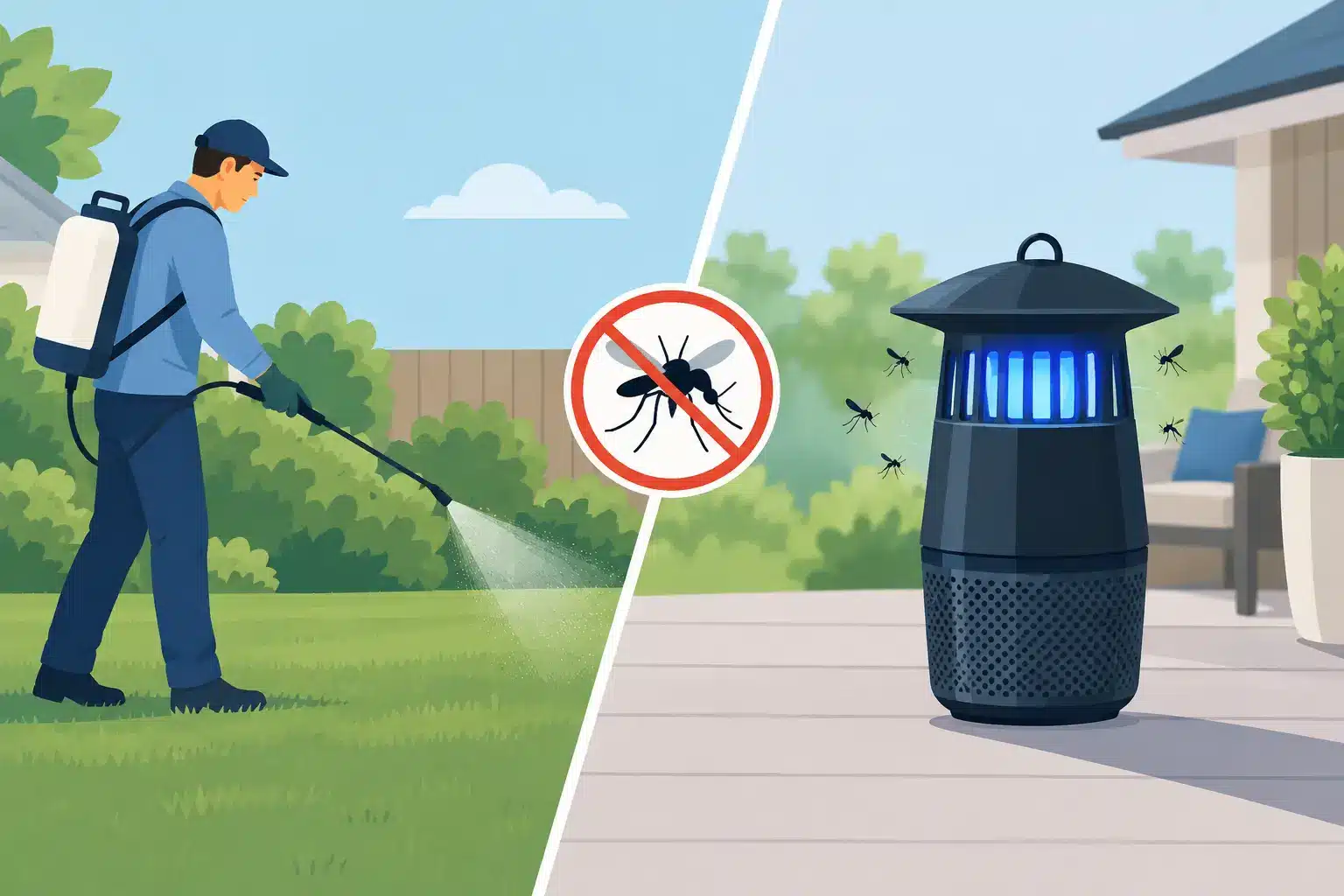
A trap glowing beside the patio can feel like progress, but it does not necessarily protect the people sitting nearby. When comparing yard spray versus mosquito traps, the practical question is not which product catches the most insects. It is which approach reduces the mosquitoes that bite your family, bother your pets, and make your yard unusable during an Ontario summer.
For many properties, mosquito traps and professional barrier treatments do different jobs. A trap may help monitor or reduce certain mosquitoes over time. A targeted yard treatment is designed to reduce the adult mosquitoes resting in the vegetation around the spaces you use now. The right choice depends on your property, your expectations, and whether you need relief for a weekend gathering or throughout the season.
How Mosquitoes Use Your Yard
Mosquitoes do not spend most of the day flying around your deck. During hot or bright conditions, many species rest in cool, sheltered areas: under shrubs, in tall grass, along hedges, beneath decks, around woodpiles, and near dense ground cover. They become active when temperatures ease, especially in the morning, evening, and after rainfall.
That behaviour matters because mosquito control works best when it targets where mosquitoes live, not only where people notice them. Eastern Ontario properties often have the right mix of shade, vegetation, drainage areas, ponds, ditches, and seasonal standing water to support mosquito activity. A yard beside wetlands or wooded land can also receive new mosquitoes from beyond its property line.
Mosquitoes are more than an outdoor annoyance. Bites can disrupt sleep and outdoor routines, while some mosquitoes can carry illnesses such as West Nile virus. For pet owners, mosquitoes are also part of the heartworm risk picture. No yard treatment can create a permanent insect-free boundary, but a well-planned program can meaningfully reduce the pressure around outdoor living areas.
Yard Spray Versus Mosquito Traps: The Core Difference
A mosquito trap works by attracting mosquitoes with carbon dioxide, heat, scent lures, light, or a combination of these signals. Once drawn in, mosquitoes may be captured or killed. Traps are usually placed away from patios and entrances so they attract insects away from people.
A professional mosquito barrier treatment takes a different route. It is applied to likely mosquito resting sites, with focused attention on shaded vegetation, perimeter areas, moisture-prone sections, and other places adult mosquitoes hide. The goal is to reduce the mosquito population already using the property, especially near decks, play areas, pools, walkways, and outdoor seating.
In simple terms, traps attempt to lure mosquitoes to one location. Yard treatments reduce mosquitoes in the locations where they rest before coming out to bite. Neither option removes the need to eliminate standing water, but their strengths are not the same.
When Mosquito Traps Make Sense
A quality mosquito trap can be useful for large rural, waterfront, or heavily wooded properties where mosquito pressure is persistent. It may also appeal to homeowners who want an ongoing monitoring tool. Seeing what a trap collects can confirm that mosquitoes are active even when weather briefly changes their behaviour.
The limitation is that results can be slow and highly variable. Trap performance depends on placement, local species, wind, competing scents, weather, available breeding sites, and the size of the area being protected. A single unit may not cover a full property, particularly one with multiple seating areas or a long treed perimeter.
Traps also need regular attention. Cartridges, attractants, power sources, catch containers, and placement all affect performance. If a trap is placed too close to a patio, it can pull mosquito activity toward the area you are trying to enjoy. If it is placed too far away or in an exposed location, it may attract little at all.
For households looking for a modest layer of support over an extended season, a trap may be worthwhile. It is less dependable as a stand-alone answer for a backyard barbecue this Saturday, a child’s birthday party, or an outdoor wedding where guests expect immediate comfort.
Where Targeted Yard Treatments Have an Advantage
Barrier treatments are often the more direct solution when homeowners want fewer biting mosquitoes around the yard. Rather than waiting for mosquitoes to find a trap, a technician treats the foliage and shaded areas that support adult mosquito activity.
This approach is especially practical when a property has dense landscaping, mature trees, hedges, poor-draining corners, or a deck surrounded by vegetation. It can also be scheduled around high-use periods, including cottage weekends, family gatherings, and outdoor events. Most properties benefit from seasonal service because mosquitoes continue to emerge and move in after rain and warm weather.
Precision matters. Broad, high-volume spraying is not the same as a property-specific treatment. Mosquito Pros assesses the conditions of each yard and focuses applications where mosquitoes rest and hide. This lower-volume approach can use up to 94% less product than traditional high-volume spraying while following product labels and property-specific instructions.
A responsible treatment plan also accounts for pollinator-friendly practices. Applications should avoid flowering plants where pollinators are actively foraging, and homeowners should share details about vegetable gardens, water features, pets, children’s play equipment, and sensitive areas. A professional can provide clear preparation and re-entry guidance based on the product used and the conditions on site.
What Neither Option Can Solve Alone
A yard spray and a mosquito trap both have limits. Neither can control mosquitoes breeding in every neighbour’s yard, marsh, ditch, or wooded area. Neither can stop a fresh wave of mosquitoes after ideal breeding weather. And neither should replace basic source reduction.
Walk your property after rain. Empty water from buckets, toys, tarps, wheelbarrows, planters, and pool covers. Clear clogged gutters, refresh birdbath water regularly, and correct drainage problems where practical. Even small amounts of still water can support mosquito development, and reducing those sites makes any treatment or trap work harder for you.
Some water cannot simply be removed. Ponds, drainage features, and natural wet areas may be part of the landscape. In those cases, realistic expectations are essential. The goal is not to control every mosquito across the neighbourhood. It is to reduce the number reaching your deck, lawn, entrance, or gathering space.
How to Choose for Your Property
Choose a trap when you are comfortable with ongoing maintenance, want supplemental monitoring, and have time for it to build an effect. It may be a sensible addition on a large property, but treat manufacturer coverage claims carefully. Conditions on your land matter more than the number printed on the box.
Choose a targeted yard treatment when mosquitoes are already making outdoor time unpleasant, when you need protection around a defined area, or when an event date is approaching. It is also a stronger fit for families with children and pets who want a customized plan rather than a one-size-fits-all device.
Using both can make sense on certain properties. A barrier treatment can reduce the adult mosquitoes resting near your home, while a properly placed trap may provide another layer farther from your main living area. Still, adding tools is not automatically better. A poorly positioned trap or an unnecessary treatment schedule adds cost without improving results.
Questions worth asking before you buy or book
Consider where bites are happening, when they are worst, and what features surround that part of the yard. A patio beside thick cedars needs a different plan than an open lawn beside a drainage ditch. Also consider how quickly you need results, whether you are willing to maintain equipment, and whether ticks are a concern as well as mosquitoes.
For many Eastern Ontario homeowners, the most effective choice is a tailored seasonal strategy: remove breeding water, manage vegetation where possible, and use targeted professional service around the places your family actually spends time. That gives you a better chance of enjoying supper on the deck, letting the dog out at dusk, or hosting friends without making mosquitoes the centre of the evening.


